Brackish Registers
Claudia Lehmann
Description
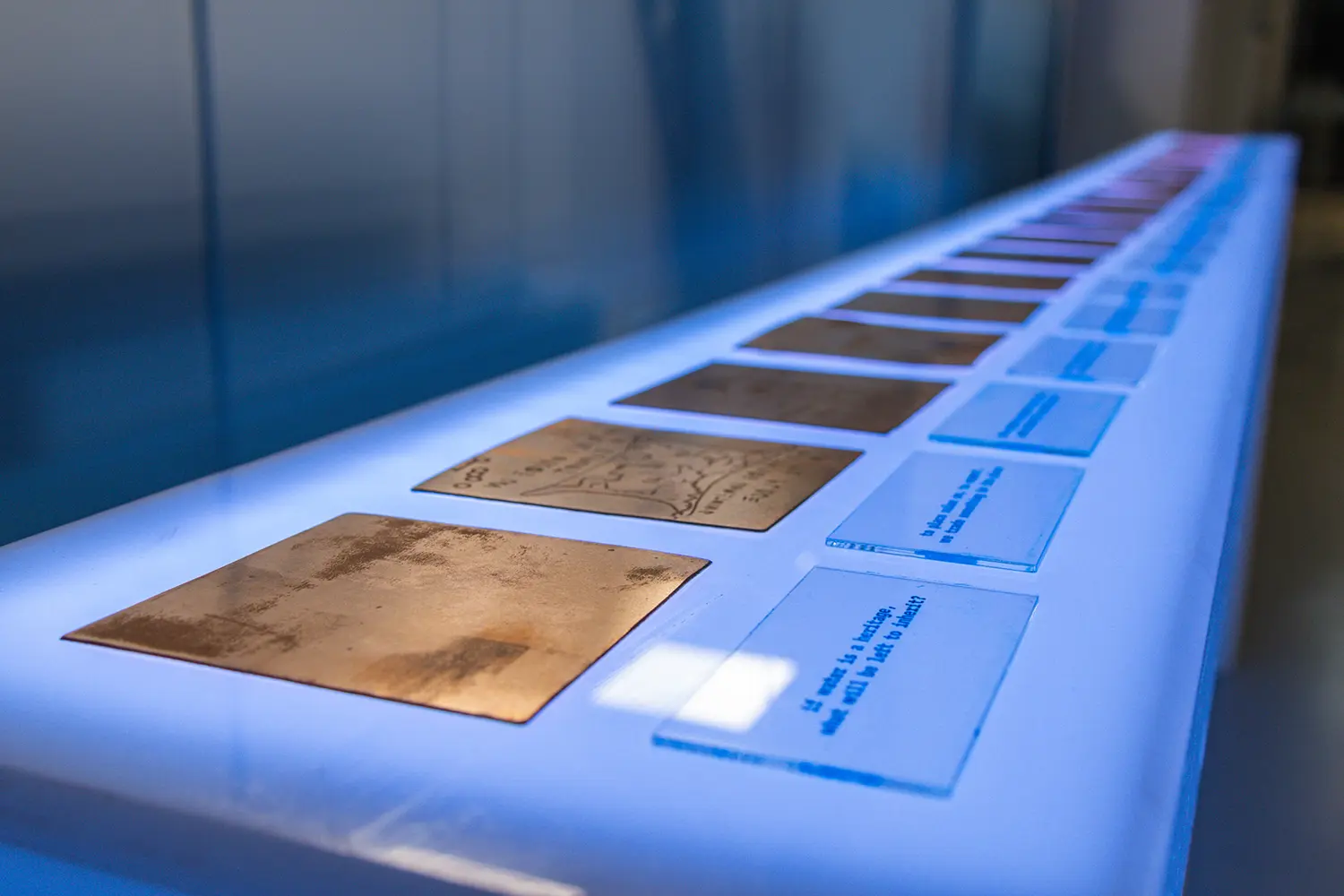
In Cyprus, aquifers face depletion and salinisation, with brackish water intrusion signalling over-extraction, climate stress and land use changes. Salt balances heritage decline, threatening water and culture, and its role as a preservative. Copper, derived from aes cyprium and formed from ancient seawater cycling through volcanic rocks, dissolves and deposits as copper sulphides when cooled. Salt in seawater enables copper transport, making brine both medium and catalyst for mineral wealth. These minerals influence photography’s history and the island’s heritage, linking mineral processes with intruding waters and cultural memory.
The work uses analogue film processes that incorporate the site’s material conditions. By submerging film in brackish waters, allowing salt crystals to mark the image and reworking these through saltwater electro-etching in copper, Brackish Registers becomes both evidence and affective archive. Water and salt inscribe themselves onto the image of the island’s heritage, transforming the medium into a witness, developed through the very crisis it records.
Affiliations
Funded by the Department of Contemporary Culture – Deputy Ministry of Culture, Cyprus, KYPRIA 2025.
Developed as part of WIP LAB 2025, organised by the CYENS Centre of Excellence.
CREDITS
Scientific Contributor: Dr. Christos Zoumides, Research Scientist, Water Department of the Energy, Environment and Water Research Center (EEWRC), The Cyprus Institute.
Claudia Lehmann
Claudia Lehmann is an artist, spatial practitioner and researcher tracing currents from the high atmosphere to the deep subsurface. Her practice examines infrastructures that enclose and extract from hydro-geo-cultural landscapes, using fieldwork and material archives to explore how traces of memory are inscribed in the land.
Claudia investigates how water moves through bodies and boundaries, foregrounding traditional knowledges and situated practices that resist dominant development narratives. Growing up in Penwith (Cornwall, UK) amongst mining histories and Neolithic sites attuned her to the entanglement of human and more-than-human forces shaping her collaborative practice in Cyprus, Crete, Coorg (India) and Cornwall.