

RPM (Routines Per Minute)
ROBO Educational & Research Robotics
Description
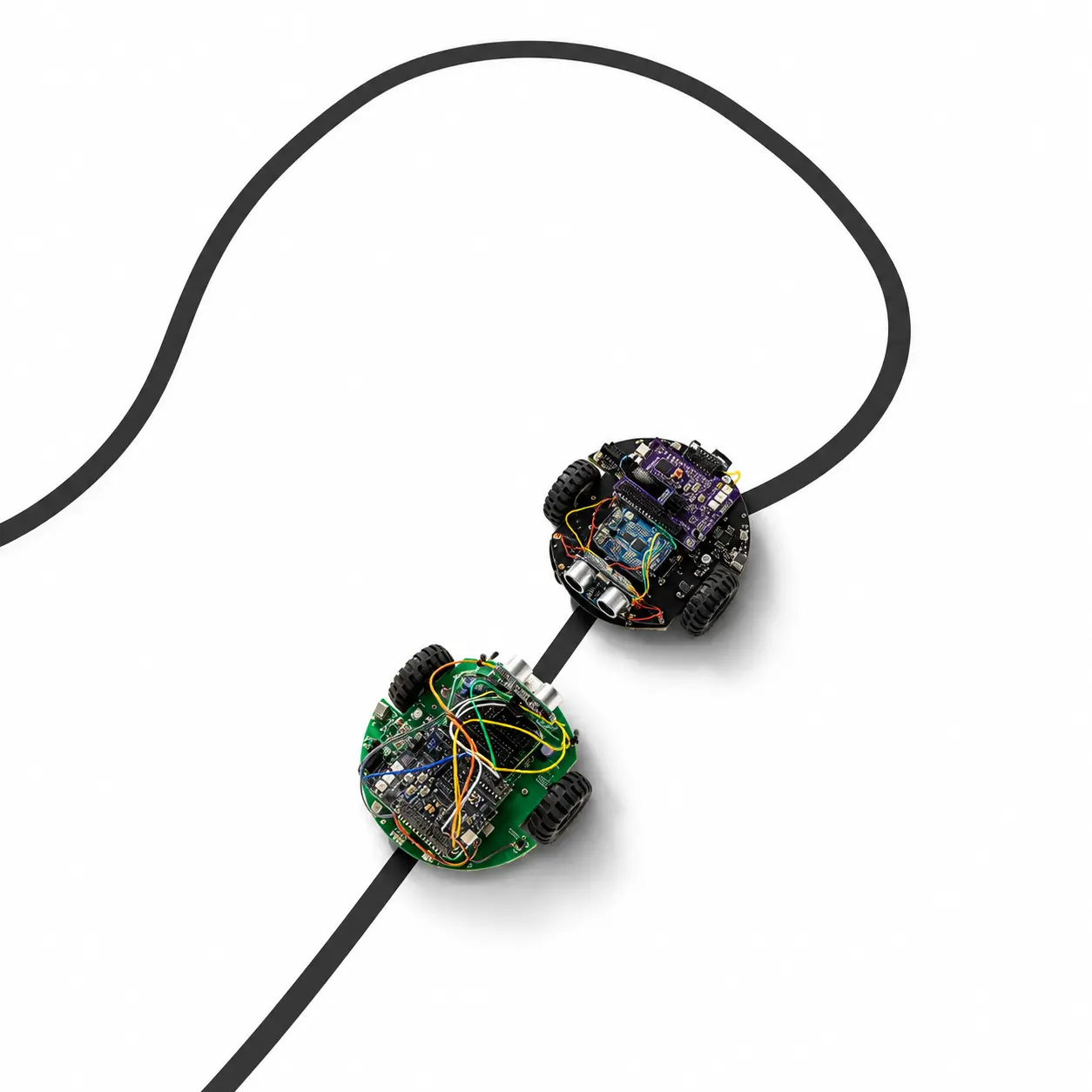
RPM (Routines Per Minute) is a kinetic installation featuring a set of black tracks on a floor. Upon this circuit, a colony of custom line-following robots operate at frantic, varying speeds. Some race with aggressive, high-speed “ambition”, while others stutter and stall, physically manifesting the psychological weight of burnout, friction and anxiety.
This artwork serves as a direct, physical metaphor for the modern human condition. The black tracks represent the rigid, predetermined paths of daily routines — the commute, the corporate ladder, the scheduled existence — where deviation is impossible. By capturing the relentless velocity of the “working living”, the robots mirror a society that prioritises mechanical productivity over human essence.
As the performance intensifies, individual machines blur into a nameless rush of motion, accompanied by the cold, rhythmic whine of micro-motors. RPM visually demonstrates how, in our frantic race to keep up with life’s accelerating loops, we ultimately surrender our individuality. The installation forces viewers to confront a chilling paradox — the faster we move along these societal lines, the faster we lose the true essence of living.
CREDITS
Odysseas Economides
Marios Christoforou
Evagoras Aristotelous
Charalambos Charalambous

ROBO Educational & Research Robotics is a Cyprus-based robotics studio founded in 2022, working at the intersection of engineering, education and social commentary. The team designs and manufactures their own hardware from the ground up — circuit boards, sensors and robots now used in over 100 schools and STEM centres across Cyprus, with technology embedded in the national school curriculum. ROBO created Cyprus’s first Arduino-compatible microcontroller board, Kypruino, and its work spans collaborations with the Ministry of Education, universities and the national robotics competition Robotex Cyprus.
With RPM, the studio turns its practice inward. The same line-following robots engineered to teach children logic and precision are recast as performers in a kinetic meditation on labour, routine and burnout. Machines built to celebrate technology become instruments for questioning it — using the cold vocabulary of automation, motors, sensors and pre-drawn paths to ask distinctly human questions about velocity, conformity and meaning.
ROBO’s team of engineers and designers brings together backgrounds in electrical engineering, embedded systems and product design, with recognition including a NASA SpaceApps People’s Choice Award and SEMICON Europa’s 20 Under 30.